
 Seasonal topicsSeptember 2, 2026· Updated on September 3, 20266 min read
Autumn allergy: ragweed and what we can do
Author: Donka Arabadzhova, Master of Pharmacy
This article is for informational purposes only and does not replace a consultation with a doctor or pharmacist about your specific condition.
How I choose topics and verify facts, read in the Editorial policy of mom.pharma.
Finding this article useful? Share it: that is how my work and knowledge reach more people.
The cold that is not a cold
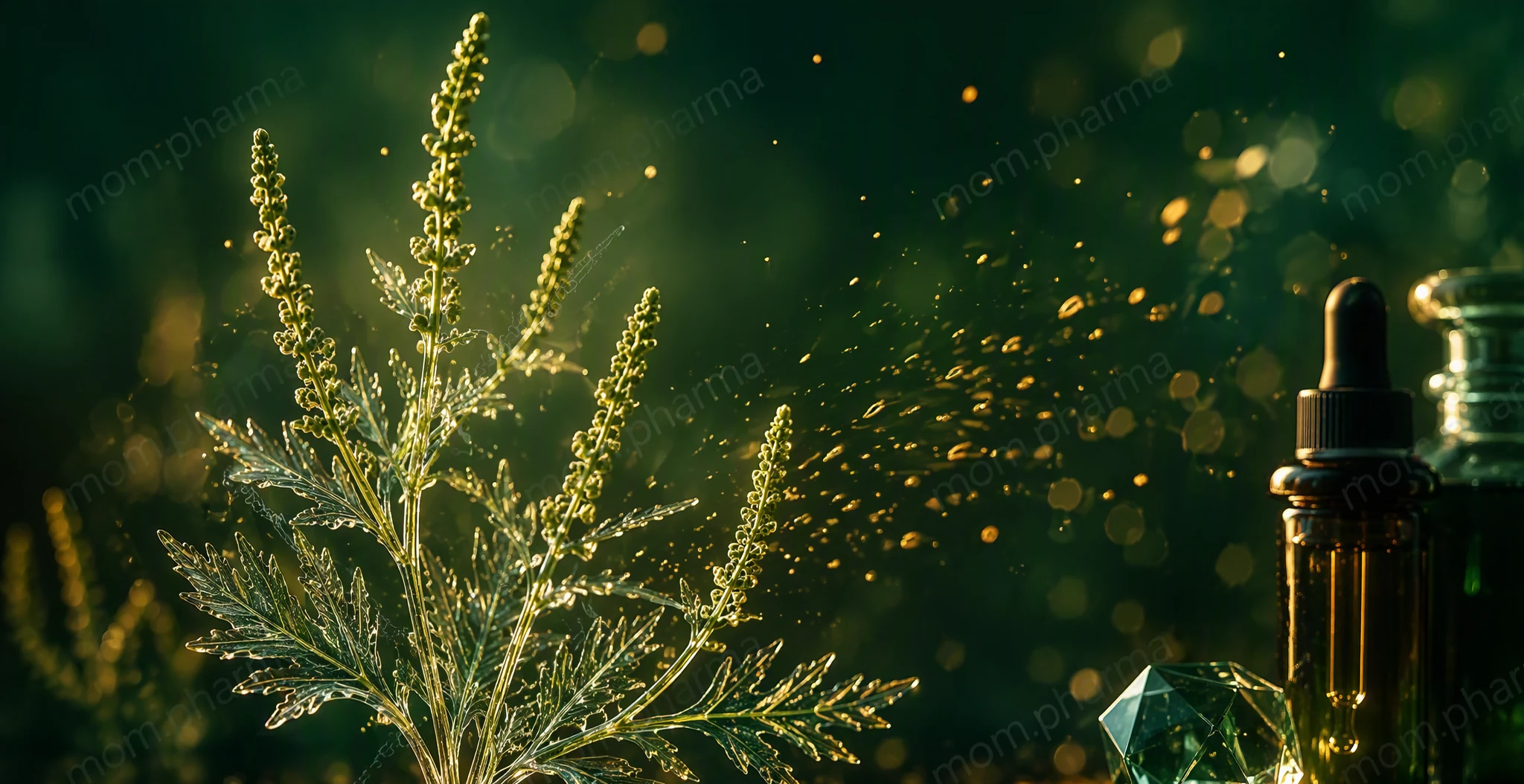
This August, three people walked into the pharmacy within a single week with the same request: something for a cold that would not go away for two weeks. All three described an itchy nose, sneezing in fits and watery eyes without fever. That is not a cold but the classic autumn allergy to ragweed, whose peak in Bulgaria is right around the start of September.
Ragweed releases pollen from late July until late autumn, and the highest concentrations here are measured between the second half of August and mid September. Hot, dry years shift flowering earlier, which was the case this season in Northern Bulgaria.
What ragweed is

Common ragweed is a herbaceous plant that arrived from North America and here grows around roadsides, railway lines, pastures and neglected plots. In Northern Bulgaria it is found massively, south of the Balkan range it is scarcer, but the wind does not respect mountains: the pollen travels hundreds of kilometres.
A single plant produces enormous amounts of pollen, and the grains are exceptionally allergenic: complaints start even at low concentrations in the air. European studies show that the ragweed season is lengthening into September and October, and the number of sensitised people on the continent is growing: these are people who, after previous contact with a given allergen, have developed increased sensitivity to it.
Allergy or a cold

Pollen allergy causes itching in the nose, the eyes and on the palate. Sneezing comes in series, the discharge is watery and clear, there is no fever, and the complaints last for weeks, as long as flowering lasts. Going outdoors on a dry, windy day strongly worsens the symptoms, while after rain or when staying indoors they are milder and more tolerable.
A common cold starts with a sore throat, is often accompanied by fever, and the discharge thickens after the second or third day. The symptoms subside within 7 to 10 days. If however this 'cold' returns to you every year around late August, it is time to consult an allergist. The diagnosis is made by the allergist, usually through skin prick tests or a blood test for specific antibodies.
Why ragweed must not be underestimated

In some people the allergy does not stop at a runny nose: coughing, chest tightness and wheezing appear, which are signs of asthma. Ragweed pollen is among the strong triggers of asthmatic complaints in the autumn months, including in people who have never had such a diagnosis.
Shortness of breath, wheezing in the chest and night cough are not controlled with an over-the-counter antihistamine from the pharmacy and require an immediate medical examination. This applies even more strongly to children and to people with an already diagnosed asthma.
Measures that reduce contact with pollen

Follow the pollen bulletins: during the season concentrations are announced regularly and peak days can be seen in advance. On such days keep the windows closed and air only in the evening or after rain, when the air is clean.
After returning home take a shower and wash your hair, and put the clothes straight into the wash. Do not dry laundry outdoors in the peak season, because pollen sticks to the fabrics. Outdoors wear sunglasses with a wider frame, and for mowing or garden work use a mask.
Rinsing the nose with seawater or saline solution after a walk washes the pollen off the mucosa and is safe for children too. Because this is a medical device, use it according to the instructions on the package.
What can help from the pharmacy
Second-generation antihistamines such as cetirizine, loratadine, desloratadine and fexofenadine are sold without a prescription and are the foundation for mild to moderate complaints. They are taken regularly, once daily throughout the season, not only on the days with aggravated symptoms, because this keeps the level of protection even. Starting before the flowering peak gives better control than starting in the middle of the symptoms. Do not take them on your own judgement, but consult the pharmacist in the pharmacy: they will give you full information.
For the eyes there are drops with antihistamine or mast-cell-stabilising substances. For a more stubborn rhinitis the doctor adds a nasal spray with a corticosteroid, which is the standard in moderately severe forms: the decision is taken only by the doctor after an examination.
Drops and sprays with a vasoconstrictor action, such as those with xylometazoline or oxymetazoline, give quick relief but are used for no more than 5 to 7 days. Longer use leads to a rebound effect: the mucosa gets used to them and the nose blocks even more strongly. This is a condition we see in the pharmacy every week.
The food traps few people suspect

In some ragweed allergy sufferers the immune system confuses the pollen with proteins in certain foods: banana, watermelon, melon, cucumber and courgettes. The result is itching or burning in the mouth and on the lips immediately after consumption, a reaction that is especially pronounced right in the flowering season.
Usually these reactions are mild and subside after the season ends, but swelling of the lips, tongue or throat requires a doctor. Chamomile tea can also provoke complaints, because chamomile is a botanical relative of ragweed.
The long-term solution

Allergen immunotherapy is the only treatment that acts on the cause itself, not only on the symptoms: the body is gradually trained to tolerate the pollen. It is carried out by an allergist after a confirmed diagnosis and lasts several years, and sublingual forms, placed under the tongue, exist for ragweed as well.
A good moment for a conversation with an allergist is after the end of the season, when the complaints have subsided and testing can be done calmly. The decision for immunotherapy is taken by the allergist and is individual, after investigations.
Ragweed in the yard and around the block

The plant is recognised by its deeply cut leaves, similar to those of wormwood, and by the greenish inflorescences at the top, arranged like candlesticks. Uprooting is done before flowering and always with gloves. If the plant is already flowering, it must not be mowed without a mask, because mowing lifts huge amounts of pollen into the air.
For affected municipal terrains and spaces between apartment blocks you can file a signal with the municipality. Under Bulgarian legislation ragweed is treated as a quarantine weed, property owners are obliged to destroy it, and the municipalities and the Food Safety Agency exercise control. Often one signal is enough for the risky area to be mowed before the next flowering.
When to see a doctor

At the first appearance of symptoms: only a doctor can confirm that this is an allergy to ragweed and not to house dust, moulds or something else that requires a different tactic. For children, for pregnant women and for any worsening that is not controlled with over-the-counter products, the examination is not postponed.
If you are not sure whether your complaints resemble pollen allergy or you have a question about a specific pharmacy product, write to me in the Ask Didi chat: I answer personally and free of charge, for information purposes, without diagnosis and without changing therapy.
Sources
This article was written by Donka Arabadzhova, Master of Pharmacy, and confirmed by the following sources: American College of Allergy, Asthma and Immunology (ACAAI): symptoms, cross-reactive foods and control of ragweed allergy; Lake et al., Environmental Health Perspectives 2017: spread and lengthening of the ragweed season in Europe; European Environment Agency, Climate-ADAPT: pollen and health under climate change; NHS: hay fever, symptoms and management approach.
This article is for informational purposes only and does not replace a consultation with a doctor or pharmacist about your specific condition.
I answer personally and free of charge, for information purposes only, without diagnosis and without changes to your therapy.
If this article was useful and you think it will help someone, share it. That is how my work and knowledge reach more people.