 Mother and childMythAugust 19, 20262 min read
The amber teething necklace: relief or danger
Author: Donka Arabadzhova, Master of Pharmacy
This article is for informational purposes only and does not replace a consultation with a doctor or pharmacist about your specific condition.
The product cards in it lead to pages with affiliate links: if you buy through them, I earn a small commission at no extra cost to you.
How I choose topics and verify facts, read in the Editorial policy of mom.pharma.
Finding this article useful? Share it: that is how my work and knowledge reach more people.
What marketing claims
The claim sounds beautiful: Baltic amber, warmed up by body temperature, releases succinic acid, which is absorbed through the skin and acts anti-inflammatory and pain-relieving during teething. That is why the necklace is worn around the baby's neck constantly, including during sleep.
It is exactly the combination of a natural product and a promise of drug-free relief that makes it such a strong seller. But every claim must pass two tests: does it work, and is it safe.
What science says
A laboratory study published in PMC in 2019 directly tested the claims: succinic acid is released from Baltic amber only at temperatures close to 200 degrees - a baby's skin never reaches such a temperature, so nothing is released. Even if it were, at tolerable concentrations the acid showed no anti-inflammatory effect in cell tests.
That is why the FDA officially states it has not evaluated these claims as safe or effective, and Australia's regulator TGA back in 2013 required traders to withdraw their advertisements as misleading.
The real danger: not theory, but cases
In December 2018 the FDA issued an official warning about teething jewellery after a reported death and serious injuries: an 18-month-old child was strangled by an amber necklace during a nap, and a 7-month-old baby choked on a detached bead. The risks are double: strangulation by the string around the neck and airway blockage by a detached bead, even when the necklace has a "safety clasp".
The American Academy of Pediatrics is categorical: babies should not wear any jewellery. Choking and suffocation are a leading cause of death in children under 1 year and among the top five causes between 1 and 4 years. If a parent still insists on using such a necklace: never around the neck, never without supervision and never during sleep. But the honest advice is to leave it on the shelf.
What truly soothes teething
The proven methods are simple: a cooled (not frozen) teething ring made of firm rubber, a gentle gum massage with a clean finger, a cold damp washcloth to chew under supervision. The one I recommend most often in the pharmacy is Anaftin Baby: a medical device that forms a protective film over the gum and relieves pain, without sugar and without local anaesthetics. Read the instructions of the device before use. For stronger pain the paediatrician may recommend a dose of paracetamol matched to the child's weight.
Be careful with teething gels containing benzocaine as well: the FDA warns that in small children they can cause methemoglobinemia, a dangerous condition in which the blood carries less oxygen. So they are not a solution either.
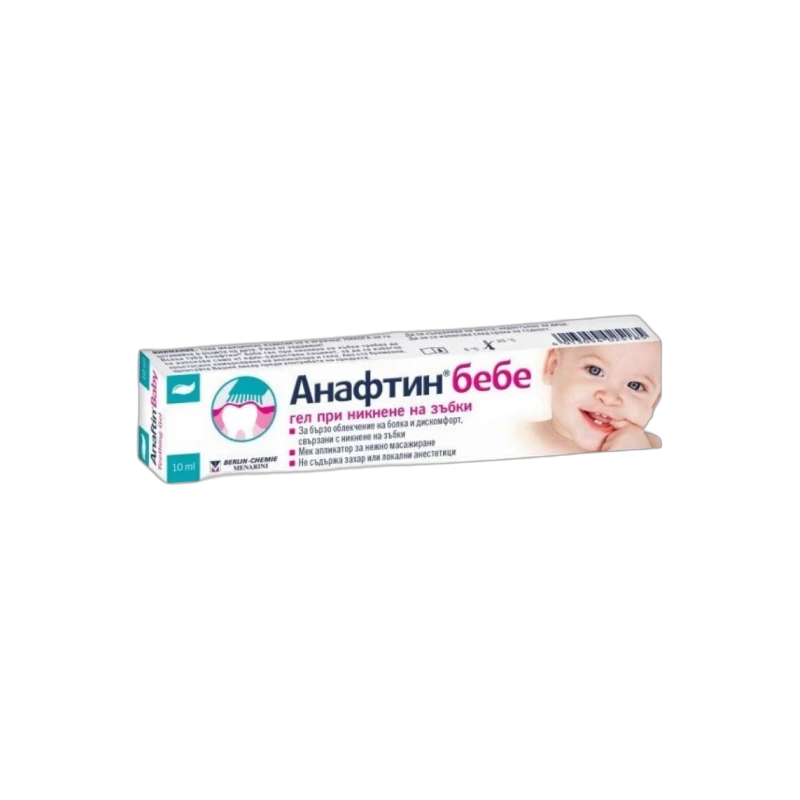
The product from this article
Anaftin Baby teething gel, 10 ml
Didi: A gel that forms an invisible protective film over the gums and relieves pain and redness during teething, without sugar and without local anaesthetics. A medical device: read the instructions and consult a doctor before use.
Sources
This article was written by Donka Arabadzhova, Master of Pharmacy, and confirmed by the following sources: the FDA safety communication on teething jewellery from December 2018, the laboratory study on succinic acid release from Baltic amber (PMC, 2019) and the American Academy of Pediatrics guidance on safe teething relief.
Final answer
Myth
This article is for informational purposes only and does not replace a consultation with a doctor or pharmacist about your specific condition. The product cards in it lead to pages with affiliate links: if you buy through them, I earn a small commission at no extra cost to you.
I answer personally and free of charge, for information purposes only, without diagnosis and without changes to your therapy.
If this article was useful and you think it will help someone, share it. That is how my work and knowledge reach more people.