 Herbs and phytotherapyAugust 22, 20265 min read
Ashwagandha: what studies show for stress and sleep, and why it is not for everyone
Author: Donka Arabadzhova, Master of Pharmacy
This article is for informational purposes only and does not replace a consultation with a doctor or pharmacist about your specific condition.
The product cards in it lead to pages with affiliate links: if you buy through them, I earn a small commission at no extra cost to you.
How I choose topics and verify facts, read in the Editorial policy of mom.pharma.
Finding this article useful? Share it: that is how my work and knowledge reach more people.
The plant people ask about every day
Ashwagandha (Withania somnifera) is a plant whose root has been used for centuries in Ayurveda. Here it is linked mostly to stress and sleep, and those are exactly the questions people bring to the pharmacy. It is often called an adaptogen, but I have to be precise: that is a traditional term with no approved health claims in the European Union. Traditional use is a fact, but it is not the same as a proven and approved effect.
And the most practical question: not everything sold as ashwagandha is the same. Most clinical studies on stress and sleep were done with specific standardised extracts. One is KSM-66: a full-spectrum extract from the root only, standardised to a minimum of 5% withanolides, produced without alcohol. The other you will meet in the literature is Sensoril. Cheap powder from an online shop may contain an unknown amount of withanolides and does not carry the studies' data. The rule I repeat: check the label for the KSM-66 brand.
What the studies measured
I start with what has the most solid base. In the Chandrasekhar study (2012), 64 adults with chronic stress took KSM-66 at 600 mg per day for 60 days. Serum cortisol, the stress hormone, fell by 27.9%, while in the placebo group the drop was 7.9%, and the stress scales showed significant improvement.
For sleep the data come from Langade (2019): 600 mg daily for 10 weeks in people with insomnia improved sleep quality, shortened the time to fall asleep and lowered anxiety on the HAM-A scale. The Akhgarjand meta-analysis (2022) summarises 12 randomised studies with over 1,000 participants and likewise finds reduced anxiety and stress at doses between 300 and 600 mg per day.
Now the honest part, which I also say in the pharmacy: the certainty of this evidence is rated low. The studies are small, the differences between them are large, and most were done with specific extracts such as KSM-66. That is why I do not talk about a miracle herb, but about a herb with promising yet limited data, with a reminder that there are no approved health claims for it in the EU.
The product from this article
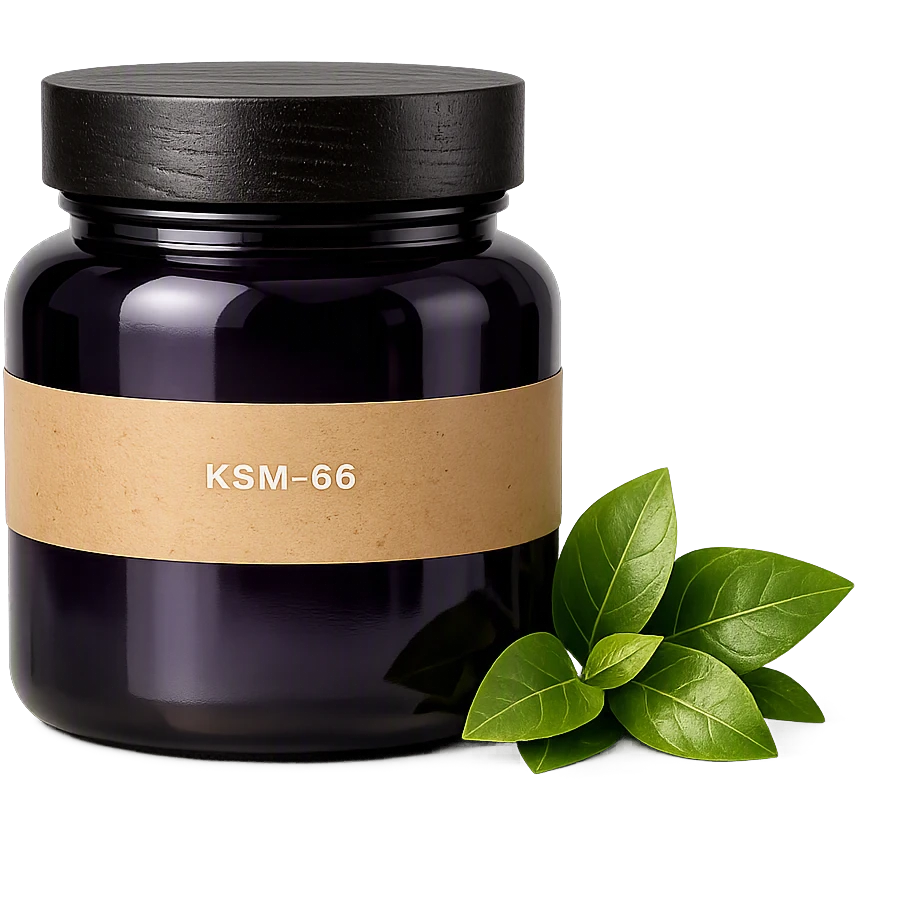
Ashwagandha KSM-66
Didi: Standardised extract, check the label for the KSM-66 mark.
How to take it sensibly
First: ashwagandha is not a sleeping pill. It does not sedate; in studies it supports sleep quality in people under stress. If insomnia lasts over a month, with night awakenings and daytime fatigue, that is a reason for a doctor, not for one more herb.
Second: the study doses are 300 to 600 mg of extract per day, and the courses run 8 to 12 weeks, after which a pause is made. Long-term safety is not established, and European regulators are currently discussing restrictions. The more the better does not apply here.
Third: ashwagandha potentiates sedation. Combining it with alcohol, sleeping pills or anxiety medicines is not a relaxing combo but a risk of excessive sleepiness. If you have a permanent therapy prescribed by a doctor and wonder whether ashwagandha is for you, ask me in the chat: I answer personally and free of charge, for information only, without diagnosis and without changing therapy.
The myths I hear
"Ashwagandha for the thyroid" is the dangerous advice circulating on Bulgarian websites. Studies show it can raise the levels of the thyroid hormones T3 and T4. In a person on levothyroxine that can lead to overdose symptoms, and ANSES explicitly advises avoiding it with thyroid disease. My answer is always one: with thyroid disease ashwagandha is not self-dosed, that is a question for a doctor.
"A hundred percent harmless herb" also fails the check. Denmark banned it in foods and supplements in 2023 after a national risk assessment. ANSES reported 8 cases of adverse reactions in France, and Björnsson (2020) describes 5 cases of liver damage with jaundice appearing between the second and twelfth week of intake. Germany also raised concerns, and in 2024 the EU designated it a priority for possible Union-wide restrictions.
"A natural sleeping pill or antidepressant" is a suggestion with no approved claims behind it. The sleep data are in people with stress, and with depression or severe anxiety the decision belongs with a psychiatrist, not in the supplement bag. And "all ashwagandhas are the same" is not true: the standardisation of the extract decides whether the product matches the studies.
When to stop the intake and for whom it is not good to take it at all
If during intake yellowing of the eyes or skin, dark urine, itching or unusual fatigue appears, the intake stops and a doctor is sought: that can be a sign of liver damage. Sudden palpitations, anxiety or weight loss are also a signal to stop and consult, because they can mean a thyroid effect.
During pregnancy and breastfeeding ashwagandha is not taken, and ANSES also notes its traditional use as an abortifacient. It is not recommended under 18 either. With thyroid disease, including Hashimoto's, with levothyroxine intake, and with liver or heart disease, it is not taken without medical supervision. And with insomnia over a month, depression or panic attacks the supplement is not the answer: that is a conversation with a doctor.
If you are looking for an option for calm sleep with approved health claims, see the article about magnesium: magnesium contributes to the normal function of the nervous system and to the reduction of tiredness and fatigue.
The product I give as an example
For ashwagandha I show the KSM-66 extract: full-spectrum, from the root of Withania somnifera only, standardised to a minimum of 5% withanolides by HPLC. This is the extract used in the clinical studies on stress and sleep at 600 mg per day, in courses of 8 to 12 weeks. It is not taken during pregnancy and breastfeeding, under 18, or with thyroid, liver or heart disease without medical supervision. There are no approved health claims for ashwagandha in the EU.
Sources
This article was written by Donka Arabadzhova, Master of Pharmacy, and confirmed by the following sources: Chandrasekhar K. et al., Indian Journal of Psychological Medicine, 2012; Langade D. et al., Cureus, 2019; Akhgarjand C. et al., Phytotherapy Research, 2022 (meta-analysis of 12 randomised trials); Björnsson H.K. et al., Liver International, 2020; the ANSES (French Agency for Food Safety) opinion on ashwagandha, 2024; official data on the KSM-66 extract from Ixoreal Biomed.
The product from this article
Ashwagandha KSM-66
Didi: Standardised extract, check the label for the KSM-66 mark.
This article is for informational purposes only and does not replace a consultation with a doctor or pharmacist about your specific condition. The product cards in it lead to pages with affiliate links: if you buy through them, I earn a small commission at no extra cost to you.
I answer personally and free of charge, for information purposes only, without diagnosis and without changes to your therapy.
If this article was useful and you think it will help someone, share it. That is how my work and knowledge reach more people.