
 Supplements and vitaminsAugust 22, 20268 min read
Omega-3: what to look for on the label, how much EPA and DHA you need and when the dose becomes a risk
Author: Donka Arabadzhova, Master of Pharmacy
This article is for informational purposes only and does not replace a consultation with a doctor or pharmacist about your specific condition.
The product cards in it lead to pages with affiliate links: if you buy through them, I earn a small commission at no extra cost to you.
How I choose topics and verify facts, read in the Editorial policy of mom.pharma.
Finding this article useful? Share it: that is how my work and knowledge reach more people.

At least two customers show up in the pharmacy every week
One of them places a jar of fish oil from the organic shop on the counter and asks whether it suits the whole family. The other recurring case is a person after a heart attack who asks whether to stop the statin and rely on omega-3 alone. Because he has heard that omega-3 protects the heart and the brain by stopping the clogging of the blood vessels, and the question looks logical, since fish oil protects the heart. Both questions deserve a precise answer. Here I will explain in plain language: which number on the label matters, what the large studies measured, and for whom a high dose harms more than it helps.
The confusion starts with the name itself. Oil from the flesh of fish, such as salmon, mackerel or tuna, delivers mainly EPA and DHA. Cod liver oil contains, besides those, serious amounts of vitamin A and vitamin D. The difference is not small: in high doses vitamin A is dangerous during pregnancy and for small children. That is why my first question is always the same: is this oil from liver or from flesh? Before I say anything at all, I always read the label of what the person has brought and ask who it is for: whether there are small children in the family who will be given it too, and whether it will be taken by a pregnant woman. Once we have cleared up what the oil is made from, the next question follows: what is actually proven.
What the label is allowed to say and what the studies measured
In the European Union omega-3 has approved health claims, and they are very specific: EPA and DHA contribute to the normal function of the heart, while DHA contributes to the maintenance of normal brain function and normal vision (EFSA, 2010). The conditions are: 250 mg of EPA plus DHA per day for the heart and 250 mg of DHA daily for the brain and vision. The same 250 mg is the adequate daily intake for adults.
On the other side stands the large 2020 Cochrane review by Abdelhamid and colleagues: omega-3 supplements most likely have little or no effect on overall mortality, coronary events may decrease slightly, and triglycerides genuinely fall. There is no contradiction: a supplement remains a supplement, it is not a medicine.
The most convincing cardiovascular data come from the prescription drug icosapent ethyl in the REDUCE-IT trial (Bhatt and colleagues, 2019): in patients on a statin it lowered the combined cardiovascular endpoint by 25% relative, but at 4 g per day, and not for just anyone. That is a prescription medicine, prescribed by a doctor. This is exactly where the self-deception I meet regularly appears: a person with a past heart attack stops the statin because the oil protects the heart. No supplement replaces prescribed therapy, and stopping a statin without a doctor is a risk not worth taking. That, however, is not the only risk: there is one more, measured and documented.
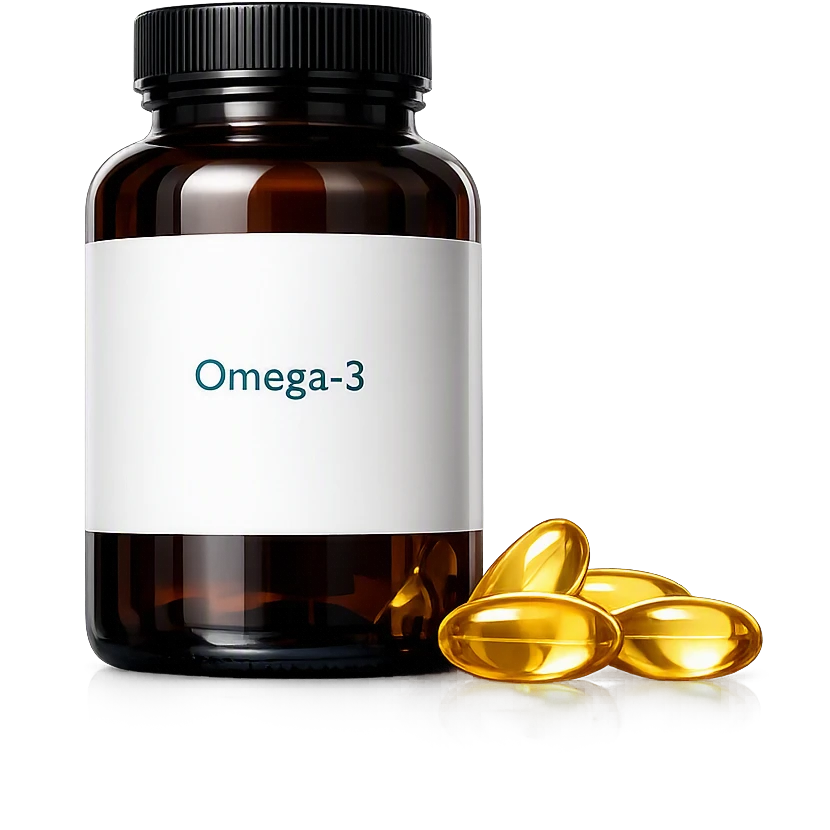
The product from this article
Omega-3 fish oil
Didi: Look at the EPA and DHA content per dose, not just the milligrams of oil in the capsule.
The risk almost nobody talks about

With high doses there is something almost no advertisement mentions. The meta-analysis by Gencer and colleagues (Circulation, 2021) with over 81,000 participants links the intake of omega-3 from fish or algae to a 25% higher risk of atrial fibrillation, and above 1 g per day the risk jumps by 49%. An older person with a history of arrhythmia who buys a high-dose product for the heart may achieve exactly the opposite result. A bigger number does not mean safer protection.
I add two more EFSA positions (2012) to the account: at intakes between 2 and 6 g daily a slight rise in LDL cholesterol is observed, and gastrointestinal complaints are a frequent companion of large doses. These are not reasons for fear, but reasons to choose the dose with your head, not by the principle of the more the better. And how to choose sensibly: the three checks I run with every customer.
The label: the checks I run with every customer

The rule I teach people: look at the EPA and DHA content per daily dose, not the milligrams of oil in the capsule. A 1000 mg oil capsule does not mean 1000 mg of EPA plus DHA. In cheap products the concentration is often around 30% or lower, and the daily dose does not even reach 250 mg. For triglycerides and blood pressure you need 2 and 3 g of EPA plus DHA per day respectively, which the standard capsule does not deliver at all.
A check I run very often on the label comes from customers who complain that when burping appears, it smells of fish: that is not a defect, but a typical phenomenon with cheap ethyl esters. Fatty acid ethyl esters (FAEE) are chemical compounds obtained by binding fatty acids with ethanol. Quality is spoken for by oxidation markers such as TOTOX, the voluntary IFOS and GOED certifications, and the form of the fatty acids, ethyl esters or triglycerides. In food supplements (such as omega-3) ethyl esters are the cheaper and less absorbed form of the product compared to natural triglycerides. But the fish smell also depends on storage: a dark and cool place; if you do not do that, the fish smell appears after intake.
Another check I run on the label is needed when the customers are vegans, vegetarians or people with fish allergy. Refined fish oils keep traces of fish proteins, so with a severe allergy I do not hand them out without consulting the person about whether they have a fish allergy. An alternative exists: DHA from microalgae, without fish origin. Exactly this alternative is for this group of people: vegans, vegetarians and people with fish allergy. For pregnant women asking about DHA, algae are an option too: maternal DHA intake contributes to the normal brain development of the foetus and of breastfed infants at 200 mg of DHA daily, in addition to the 250 mg of EPA plus DHA (an approved EU claim). The condition during pregnancy stays the same: no cod liver oil because of vitamin A. Once these checks are done, a few claims I hear from people or see on the Bulgarian internet remain to be debunked.
The myths spreading on the internet

"Fish oil thins the blood." There is no such approved health claim in the EU, and EFSA (2012) found no clinically significant effect on blood clotting up to 5 g per day. In people on anticoagulants such as warfarin, apixaban or rivaroxaban an interaction is possible at high doses, but it comes from potentiating the drug effect, not from thinning. That is settled by the doctor.
"Flaxseed and walnuts are enough." Plant ALA (alpha-linolenic acid) is an essential omega-3 polyunsaturated fatty acid of plant origin. It is a healthy food, but its conversion to EPA is only about 5 to 10%, and to DHA about 2 to 5% (Gerster, 1998). For 250 mg of EPA plus DHA from flaxseed you would need amounts nobody eats. ALA is not a substitute for EPA and DHA.
"All omega-3s are the same as long as it says fish oil." That is not exactly so: two 1000 mg capsules can carry radically different amounts of EPA and DHA, and the forms differ too. Do not believe the promise of a best form either: there is no evidence for such a conclusion. Trust the dose and the quality standards. The most important part remains: when the supplement is not the answer to your problems at all.
When the supplement is not the answer
Chest pain, shortness of breath, palpitations or a skipping heart, especially with high-dose intake: that is a reason for a cardiologist, not a new box of capsules. Triglycerides above about 5.6 mmol/L mean a risk of pancreatitis and are the doctor's job; the supplement is not a treatment. With anticoagulants or a planned operation, high doses are discussed in advance, and stopping before surgery happens only by medical judgement.
During pregnancy: no cod liver oil, DHA within the approved doses, agreed with a pharmacist or doctor. With an allergy to fish or seafood: nothing without consultation, the alternative is DHA from algae. And the two customers from the beginning get one and the same answer: first the label and the doctor, then the capsule.
If you are curious how labels are read for other supplements too, in the article about magnesium I explain the differences between the forms by absorption and tolerance. And if you are holding a specific box and want us to read it together, ask me in the chat: I answer personally and free of charge, for information only, without diagnosis and without changing therapy.
Sources
This article was written by Donka Arabadzhova, Master of Pharmacy, and confirmed by the following sources: Regulation (EU) No 432/2012 (approved health claims for EPA and DHA); the EFSA opinion on dietary reference values for fats (EFSA Journal 2010;8(3):1461); the EFSA opinion on the tolerable upper intake level (EFSA Journal 2012;10(7):2815); Abdelhamid A.S. et al., Cochrane Database of Systematic Reviews, 2020; Bhatt D.L. et al., New England Journal of Medicine, 2019 (the REDUCE-IT trial); Gencer B. et al., Circulation, 2021; Gerster H., International Journal for Vitamin and Nutrition Research, 1998.
The product from this article
Omega-3 fish oil
Didi: Look at the EPA and DHA content per dose, not just the milligrams of oil in the capsule.
This article is for informational purposes only and does not replace a consultation with a doctor or pharmacist about your specific condition. The product cards in it lead to pages with affiliate links: if you buy through them, I earn a small commission at no extra cost to you.
I answer personally and free of charge, for information purposes only, without diagnosis and without changes to your therapy.
If this article was useful and you think it will help someone, share it. That is how my work and knowledge reach more people.