
 Seasonal topicsAugust 17, 20265 min read
Summer food safety: the rules that protect the whole family
Author: Donka Arabadzhova, Master of Pharmacy
This article is for informational purposes only and does not replace a consultation with a doctor or pharmacist about your specific condition.
The product cards in it lead to pages with affiliate links: if you buy through them, I earn a small commission at no extra cost to you.
How I choose topics and verify facts, read in the Editorial policy of mom.pharma.
Finding this article useful? Share it: that is how my work and knowledge reach more people.
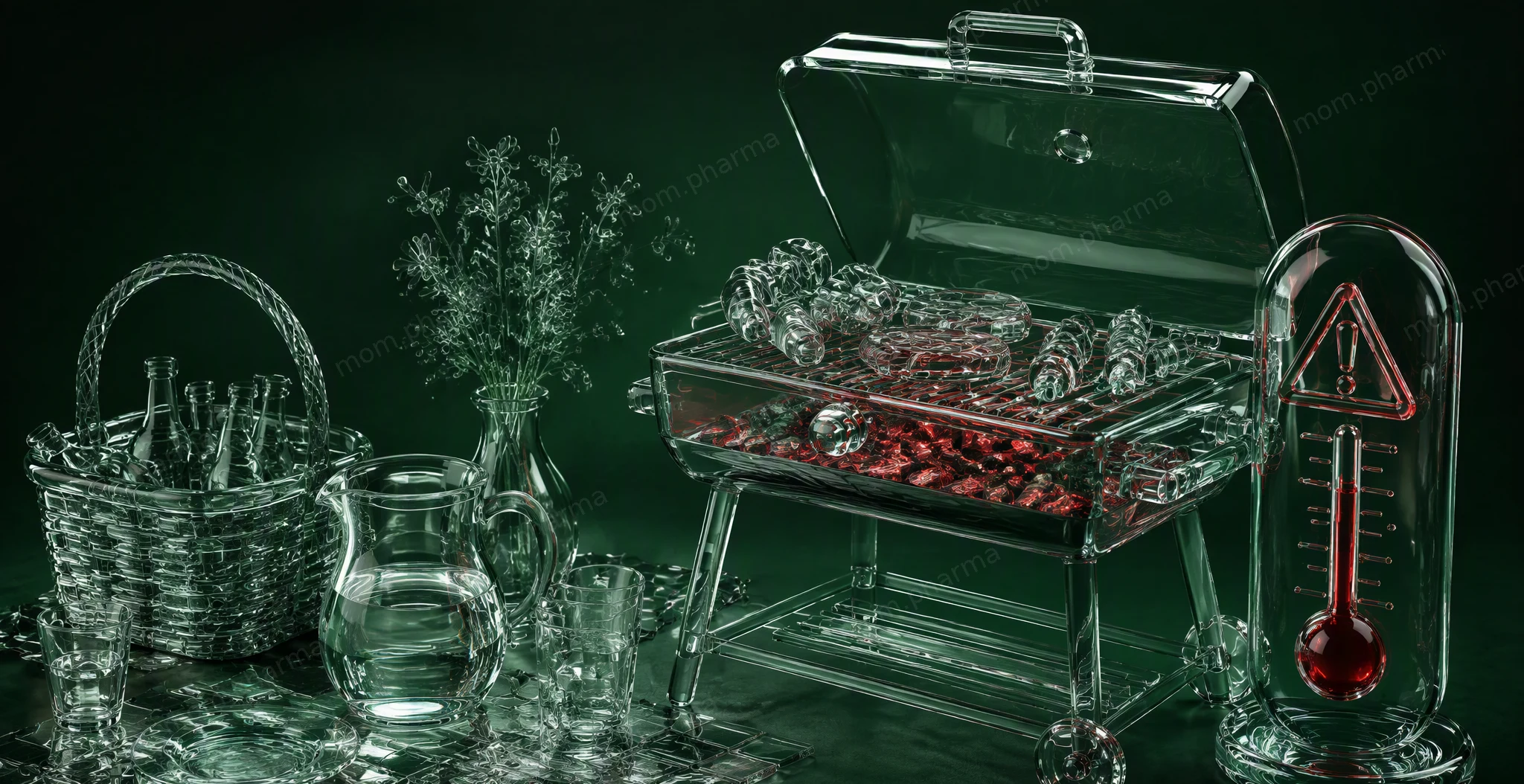
Why summer is the season of food poisoning
According to the World Health Organization, one in ten people worldwide falls ill from food every year. In summer the risk jumps, because heat speeds up bacterial growth while we eat outdoors: on the beach, at a picnic and on the road.
The good news is that most cases are prevented with a few simple rules. They are the same ones that WHO, CDC and food regulators teach professional kitchens around the world, only applied here to your everyday life.
The danger zone: between 4 and 60 degrees
The bacteria behind food poisoning multiply fastest between 4 and 60 degrees Celsius. That is why this range is called the danger zone. Cold food should stay below 4 degrees and hot food above 60 until it is served.
Your home fridge should hold no more than 4 degrees: check it with an inexpensive fridge thermometer, because in summer compressors often fail to compensate for the heat, especially when the door is opened frequently.
The two-hour rule

This is the most important summer rule: perishable food does not stay out for more than 2 hours. When the temperature is above 32 degrees, and at the beach it almost always is, the time shrinks to 1 hour. After that the food is thrown away, even if it looks and smells normal.
The rule also applies to dinner leftovers on the terrace. Put them in the fridge on time, spread in shallow containers so they cool quickly, and eat them within 3-4 days. Meat is never thawed on the counter, only in the fridge, in cold water or in the microwave.
The beach and the picnic

A cooler bag is not a luxury but a must: ice or frozen water bottles keep food below 4 degrees. Raw meat is packed at the very bottom in a sealed container so it cannot drip onto ready-to-eat food, and ideally travels in a separate bag.
Fruit and vegetables are washed under running water at home before leaving, not in the sea at the beach. Drink only bottled or proven safe water and watch the ice cubes from beach bars: they are one of the common causes of problems.
Safe grilling
Separate boards, tongs and plates for raw and cooked meat: this is the rule most often broken at home. Cooked meat never goes back onto the plate that held it raw, unless that plate has been washed with hot water and soap.
The colour of meat is not a reliable sign of doneness. A kitchen thermometer is the only sure way: poultry to 74 degrees in the thickest part, minced meat and burgers to 71, steaks and fish to 63, with the steaks then needing to rest for 3 minutes before serving.
The truth about mayonnaise and salads
Mayonnaise has a bad reputation, but it is rarely the culprit itself. More often the problem is the boiled eggs, chicken or potatoes in the salad that spent hours in the heat. Still, every mayonnaise or dairy dressing speeds up spoiling, so such salads stay in the fridge until the moment of serving.
The same goes for ready-made food from beach stalls and bars: if a sandwich or salad has been sitting in a display without cooling, do not buy it. Food from summer stalls is one of the most common sources of poisoning during the holidays.
When food is thrown away without hesitation
The rule of food regulators is unambiguous: when in doubt, throw it out. Smell and taste are not reliable tests, because many dangerous bacteria and toxins change neither, and trying a spoonful only adds risk.
We throw away any food that has spent more than 2 hours in the heat, anything with a changed smell, colour or texture, and everything past its expiry date. The saved dinner is not worth three days of diarrhoea.
If poisoning still happens
Most food poisoning passes on its own within a few days, and the most important thing is replacing water and electrolytes: sip water often in small amounts, and with diarrhoea and vomiting add an oral rehydration sachet from the pharmacy. It is also an essential part of the summer travel medicine kit.
Eat when you feel like it, lightly and without fatty or spicy food, and skip fruit juices and fizzy drinks: they worsen diarrhoea. With nausea and vomiting the most important thing is fluid intake in small sips. As an addition to them, pharmacies also carry a sodium citrate syrup, a food supplement with a version for children from 7 months: both verified products are shown here and at the end of the article. Anti-diarrhoea medicines such as loperamide are for adults only, are not given to children under 12, and are not taken with blood in the stool or high fever.

The product from this article
Recommended by DidiSodium citrate Alfa, syrup, 100 ml
Didi: A food supplement with sodium citrate, for adults and children over 6 months. If the vomiting does not stop, see a doctor.

The product from this article
Sodium citrate Niksen, syrup, 100 ml
Didi: A food supplement with sodium citrate, suitable for children from 7 months and the whole family. If the vomiting does not stop, see a doctor.
When to see a doctor
Medical help is sought immediately at signs of dehydration (rare and dark urination, dry mouth, dizziness), blood in the stool or vomit, vomiting for more than 2 days or diarrhoea for more than 7 days, as well as high fever that does not come down.
With a baby under 12 months, a small child, a pregnant woman, an older person or someone chronically ill, do not wait: call a doctor at the first symptoms. In a severe condition with confusion, fainting or inability to keep down even sips of water, call 112.
Sources
This article was written by Donka Arabadzhova, Master of Pharmacy, and confirmed by the following sources: the World Health Organization's five keys to safer food, CDC's four steps to food safety (clean, separate, cook, chill), the FDA and USDA guidance on outdoor food and the two-hour rule, and the NHS page on food poisoning and home care.
The product from this article
Sodium citrate Alfa, syrup, 100 ml
Recommended by DidiDidi: A food supplement with sodium citrate, for adults and children over 6 months. If the vomiting does not stop, see a doctor.
The product from this article
Sodium citrate Niksen, syrup, 100 ml
Didi: A food supplement with sodium citrate, suitable for children from 7 months and the whole family. If the vomiting does not stop, see a doctor.
This article is for informational purposes only and does not replace a consultation with a doctor or pharmacist about your specific condition. The product cards in it lead to pages with affiliate links: if you buy through them, I earn a small commission at no extra cost to you.
I answer personally and free of charge, for information purposes only, without diagnosis and without changes to your therapy.
If this article was useful and you think it will help someone, share it. That is how my work and knowledge reach more people.