
 Seasonal topicsAugust 15, 20265 min read
Summer travel medicine kit: a pharmacist's full list
Author: Donka Arabadzhova, Master of Pharmacy
This article is for informational purposes only and does not replace a consultation with a doctor or pharmacist about your specific condition.
The product cards in it lead to pages with affiliate links: if you buy through them, I earn a small commission at no extra cost to you.
How I choose topics and verify facts, read in the Editorial policy of mom.pharma.
Finding this article useful? Share it: that is how my work and knowledge reach more people.

Why a travel kit is not just a smaller home kit
At home you know where the pharmacy is and what the packaging says. On holiday, especially abroad, the same medicine carries a completely different brand name, labels are in an unfamiliar language, and in small resorts the pharmacy can be closed exactly when you need it. That is why the travel kit is prepared in advance and with intention.
The good news is that about ten well-chosen items cover the vast majority of problems that ruin holidays. Here is the list I give to patients in the pharmacy every summer, ordered by how often the problems actually occur.
The core kit that saves a holiday
A pain and fever reliever (paracetamol or ibuprofen), an antihistamine for allergic reactions and bites, a digital thermometer and tweezers. This is the core you never travel without.
Plasters in several sizes, sterile gauze, medical tape and an antiseptic solution or wipes for wounds. A hydrocortisone cream helps with redness and reactions after bites, and blister plasters save your feet after long walks in new places.
Sunscreen with SPF 30 or 50+ for the body and a separate product for the face, a lip balm with sun protection and an insect repellent with a proven active ingredient (DEET or icaridin). If you get motion sickness in a car, bus or boat, add a product with dimenhydrinate: travel sickness is far easier to prevent than to control once it has started. Repellents are biocides: use them safely and read the label before use.
The product from this article
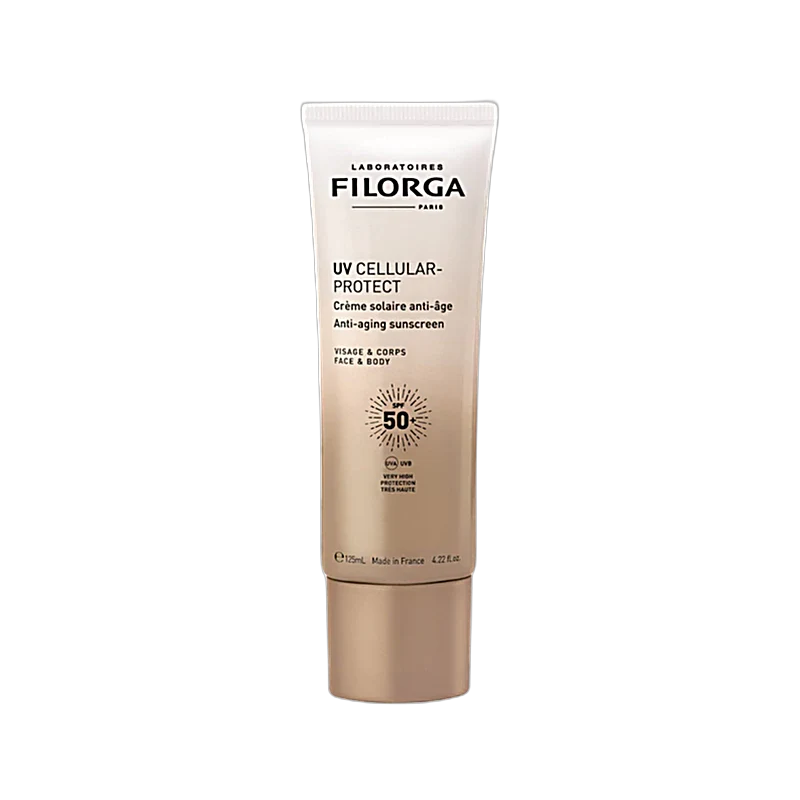
Recommended by DidiFilorga UV-Cellular Protec sunscreen cream for face and body SPF 50+
Didi: High antioxidant protection for face and body that also guards against photoageing, without a heavy feel.
Leads to the product page with an affiliate link: if you buy through it, I earn a commission at no extra cost to you.
Stomach trouble: the most common problem on the road
Travellers' diarrhoea affects up to 40 percent of people travelling to high-risk destinations and is the number one cause of ruined trips. The most important thing is not stopping it quickly, but rehydration: lost fluids and electrolytes are replaced with oral rehydration salts dissolved in the stated amount of safe water, usually 1 litre.
Loperamide relieves symptoms when you face a long bus ride or flight, but it has important exceptions: it is not used for bloody diarrhoea or diarrhoea with high fever, and in children under 12 years it is not used at all. For children, rehydration is the first and main measure.
With vomiting the same rule applies: fluids in small but frequent sips. Oral rehydration salts are given a few sips at a time every 5 to 10 minutes, because a large amount at once provokes new vomiting. If vomiting does not stop within a few hours, if there is blood or severe abdominal pain, or if a child cannot keep down even a little fluid, seek medical help immediately.
Seek a doctor locally if there is blood in the stool, fever, vomiting that prevents fluid intake, or if symptoms do not settle within 48 to 72 hours. With small children, pregnant women and older adults, do not wait that long.
Medicines on the plane: rules few people know

Tablets and capsules travel freely in hand luggage with no quantity limit. Liquid medicines over 100 ml are also allowed, as long as they are needed for the journey and you carry a prescription or a doctor's note for them. Inhalers, insulin syringes and cooling gel packs for medicines also pass security.
All important medicines travel in hand luggage, never in checked baggage. A lost or delayed suitcase must not mean interrupted treatment. Keep them in their original packaging with the labels and carry a copy of the prescriptions, preferably in English.
Insulin is a special case: it must not go into checked baggage, because the low temperatures in the cargo hold damage it. Carry it in hand luggage in a cooling pouch, accompanied by a doctor's note, and present it separately at screening if asked.
Warning: medicines that are banned in some countries
What is sold normally in a Bulgarian pharmacy can be illegal elsewhere, and what matters is the active substance, not the brand name. Codeine, found in some combined painkillers, is restricted even in Greece, and in Japan, the UAE, Singapore and Thailand it is strictly controlled or banned.
Pseudoephedrine from some cold remedies is banned in Japan, Singapore, the UAE and Mexico. Sedatives and sleep medicines such as diazepam and zolpidem require prior permission in many countries. Penalties range from confiscation to detention, so the risk is simply not worth it.
The rule is simple: before travelling outside the European Union, check the destination's requirements on its embassy's website. Within the EU, carry the prescription for your prescription medicines and take a quantity for personal use only, usually for about 30 days.
Chronic conditions, documents and final tips
With a chronic condition, take medicines for the whole stay plus a reserve of a few days, because delays and plan changes happen. Prepare a short medical summary in English with your diagnoses, medicines by their international (not brand) names and any allergies. It saves precious time if medical care is needed abroad.
The European Health Insurance Card is issued free of charge by the Bulgarian NHIF and gives you access to state-provided medical care in EU countries under the same conditions as local residents. Arrange it in good time before the trip. It does not replace travel insurance, but it is the first and easiest step.
In pregnancy, heart disease, diabetes or plans for high-altitude and exotic destinations, preparation requires a conversation with your doctor in advance. And if you wonder whether a specific product from the list suits you or your children, ask me in the chat: I answer personally and free of charge, for information purposes only, without diagnosis and without changes to your therapy.
Sources
This article was written by Donka Arabadzhova, Master of Pharmacy, and confirmed by the following sources: CDC Yellow Book 2026 (chapters Travel Health Kits, Travelers' Diarrhea and Traveling with Prohibited or Restricted Medications), the NHS Fit for Travel recommendations, the European aviation rules for medicines in hand luggage and the Bulgarian NHIF information on the European Health Insurance Card.
The product from this article
Filorga UV-Cellular Protec sunscreen cream for face and body SPF 50+
Recommended by DidiDidi: High antioxidant protection for face and body that also guards against photoageing, without a heavy feel.
Leads to the product page with an affiliate link: if you buy through it, I earn a commission at no extra cost to you.
This article is for informational purposes only and does not replace a consultation with a doctor or pharmacist about your specific condition. The product cards in it lead to pages with affiliate links: if you buy through them, I earn a small commission at no extra cost to you.
I answer personally and free of charge, for information purposes only, without diagnosis and without changes to your therapy.
If this article was useful and you think it will help someone, share it. That is how my work and knowledge reach more people.