
 Supplements and vitaminsAugust 26, 20268 min read
Vitamin B12: deficiency, forms and when a tablet is not enough
Author: Donka Arabadzhova, Master of Pharmacy
This article is for informational purposes only and does not replace a consultation with a doctor or pharmacist about your specific condition.
How I choose topics and verify facts, read in the Editorial policy of mom.pharma.
Finding this article useful? Share it: that is how my work and knowledge reach more people.

A Wednesday afternoon and one case of tingling
A Wednesday afternoon, a few weeks ago. A man of about sixty puts his metformin prescription on the counter and mentions in passing that his toes have been going numb for months and that he gets out of bed tired in the morning. Six years on metformin and not a single vitamin B12 test. He came back ten days later with the result: 148 pg/mL against a laboratory lower limit of 200. His doctor prescribed a regimen with a follow-up, and I explained to him what you will read below.
I have this conversation at least once a week, because B12 deficiency is one of those conditions that goes unnoticed for years: it develops slowly, its symptoms resemble ten other things, and the liver reserve hides the problem for a long time. Here I have gathered how this vitamin works, who is really at risk, how the numbers are interpreted and when tablets are sufficient and when they are not.
What vitamin B12 does

The EU-approved health claims for vitamin B12 are specific and you will find them on every package label: it contributes to normal energy-yielding metabolism, to the normal functioning of the nervous system, to normal homocysteine metabolism (the process of converting this amino acid into other substances useful for the body with the help of vitamins B6, B12 and folic acid (B9)), to normal psychological function, to normal red blood cell formation, to the normal function of the immune system and to the reduction of tiredness and fatigue (Regulation (EU) No 432/2012). When you read a label that promises more than this list, it is outside the law.
The recommended daily intake is a small number: the US Institute of Medicine sets 2.4 mcg for adults, while EFSA accepts 4 mcg as an adequate intake. The body, however, stores the vitamin in the liver and the reserve lasts two to five years. That is exactly what makes the deficiency treacherous: it starts today and is felt years later, when the reserve is depleted.
The journey from the mouth to the blood

Vitamin B12 travels the most complex path of all vitamins. In food it is bound to proteins and first the stomach acid with the enzyme pepsin must release it. Then the stomach produces a protein called intrinsic factor, which attaches to the vitamin and escorts it to the last part of the small intestine. Only there do special receptors let it into the blood. If one link breaks, absorption drops, no matter how large a dose you swallow.
There is, however, a back door: about 1% of a large dose passes through the intestinal wall even without intrinsic factor, by so-called passive diffusion. This percentage is the reason tablets of 1000-2000 mcg work even in people with impaired absorption, as you will see in the studies below. The small doses of 5-10 mcg in combined multivitamins cannot pass through this back door: a microscopic amount is absorbed from them passively.
Who is in the risk group

The first group is vegans and strict vegetarians: plants do not produce B12, and sources such as spirulina contain a form the body cannot use. The second is people over 60, in whom stomach acidity often decreases and the vitamin from food stops being released. The third group is the most overlooked: people on metformin. The risk grows with the dose and the years of intake, and the American Diabetes Association recommends periodic B12 monitoring. On the same line are those taking acid-reducing medicines long-term (proton pump inhibitors and H2 blockers).
Separately are people operated on the stomach or small intestine, including after bariatric surgery (a set of surgical interventions on the digestive system aimed at lasting weight loss in severe obesity), and people with pernicious anemia (an autoimmune condition in which the body attacks the cells producing intrinsic factor). For them the problem is not the food but the broken absorption mechanism, and their therapy is lifelong, determined by a doctor.
The symptoms and the folic acid trap
The complaints are non-specific and easily mistaken for other conditions: fatigue that does not go away with sleep, pale skin, a smooth and burning tongue, tingling and pins and needles in the hands and feet, unsteadiness when walking, absent-mindedness and forgetfulness. The blood count in advanced deficiency shows anemia with enlarged red blood cells (macrocytic anemia). Each of these complaints has other causes too, which is why the diagnosis is made by a doctor with tests, not by a list on the internet.
Here is the trap few people know about: taking folic acid can make the blood count in B12 deficiency look fine and thus hide the anemia, while the nerve damage keeps progressing. That is why the two are tested together, and the nervous system problems are the reason not to wait: left untreated for too long, they can become irreversible. Tingling, an unsteady gait or memory problems are a reason for a doctor's examination, not for a supplement recommended by a forum.
The test: what to order and how to read it

The first test is serum vitamin B12. The frame most laboratories use: below 200 pg/mL is deficiency, between 200 and 300 pg/mL is a grey zone, where symptoms and additional markers reveal the full picture. Watch the units, because some laboratories report in pmol/L: 200 pg/mL is about 148 pmol/L. The limits vary between laboratories, so the reference interval of the value is printed next to the result; look at exactly that one.
When the result is borderline or the symptoms do not match the number, the doctor adds holotranscobalamin (the active part of the vitamin), methylmalonic acid and homocysteine: they show whether the cells actually receive B12. Two details from practice: do not take high doses of B12 before the test, because the result is skewed for weeks, and do not build an intake regimen from forum target values, because such tables come from opinions, not from guidelines. Interpretation is the doctor's job, just as with vitamin D, which I cover in the article on vitamin D for adults.
The forms: cyanocobalamin, methylcobalamin and the rest
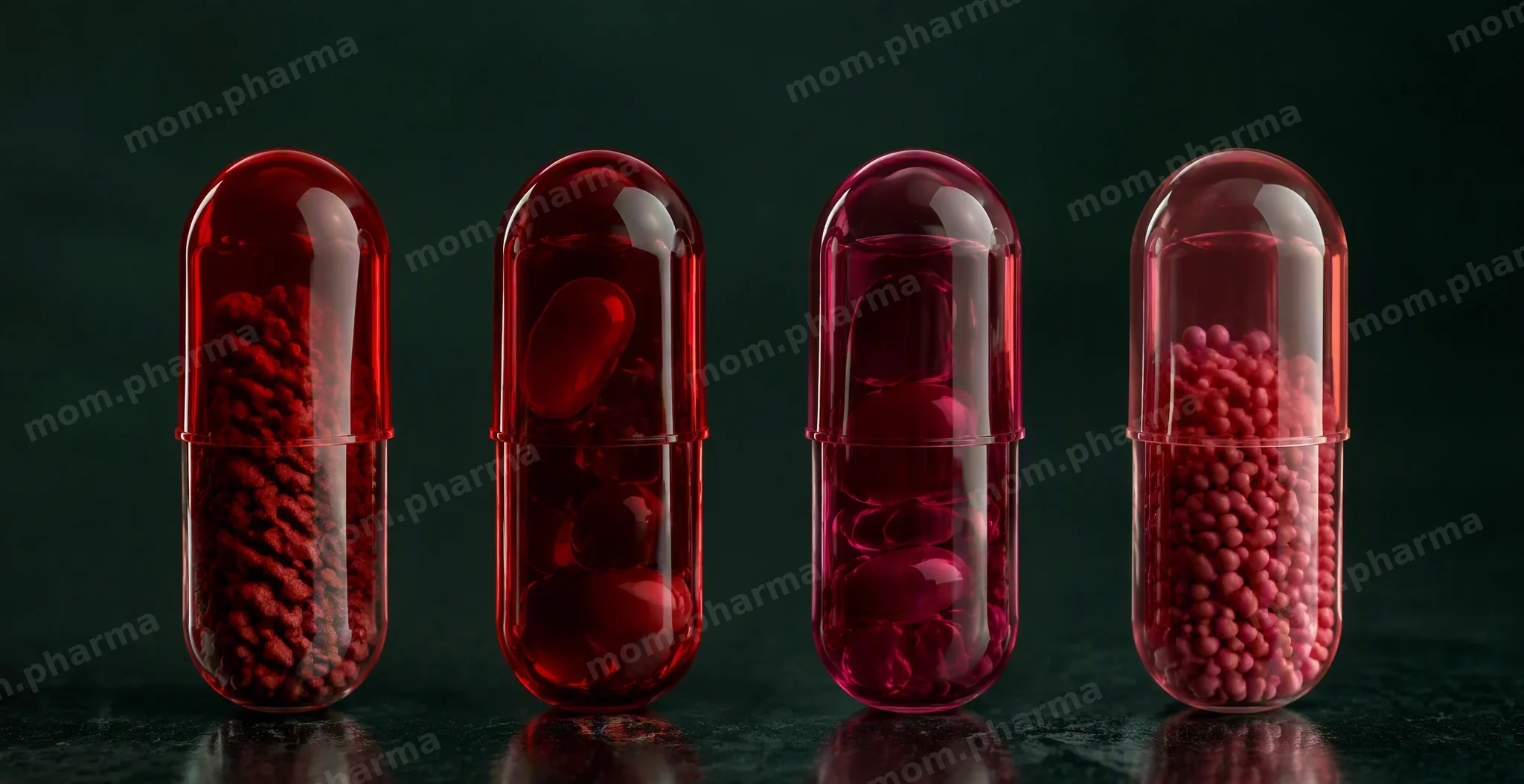
Cyanocobalamin is the most studied and stable form: from it the body produces the two active forms, methylcobalamin and adenosylcobalamin. That is why it is the standard in most studies and medicinal products. Methylcobalamin is an active form and a perfectly acceptable choice, but studies do not show an advantage for most people that would justify the higher price. Hydroxocobalamin stays longer in the body and is the form in many injectable products.
A conclusion from accumulated experience and practice: the difference between the forms is smaller than the advertisements claim, and the dose and absorption decide. If the label says active form and this product costs triple, ask what exactly it is. For a healthy person with a dietary deficiency, cyanocobalamin in the right dose does the same job as methylcobalamin, but at a normal price.
Tablet or injection: what the studies show
The classic randomized study by Kuzminski from 1998 (Blood journal) compares 2000 mcg orally daily with 1000 mcg by injection and finds no difference between the two, and in places even better recovery with the oral regimen. The 2018 Cochrane review summarizes the three available trials: the evidence is limited but shows no difference in favor of injections at doses of 1000-2000 mcg. A 2025 meta-analysis with 16 studies and over 6,000 participants confirms: between oral, sublingual and injectable intake there is no statistically significant difference either for B12 levels or for homocysteine. The back door of passive diffusion explains why.
And here is the delicate point the forums keep silent about: vitamin B12 injections are a medicinal product dispensed with a prescription, and the decision for them is made by the doctor. They remain the standard in pernicious anemia, in neurological symptoms, in severe deficiency after stomach or intestinal surgery, and whenever the doctor judges that tablets are not reliable. Self-prescribing injections on advice from the internet is dangerous and unnecessary: for most people the high-dose tablet achieves the same without a needle.
How long to take it: there is no universal regimen
A regimen of three months on, a month and a half off, then a test circulates in the forums. It does not come from a reliable and competent source but from word of mouth. The real duration depends on the cause: with a dietary deficiency the intake lasts a few months with a follow-up test after 8-12 weeks; with pernicious anemia the therapy is lifelong; and for people on metformin the supplement is taken as long as the medicine is taken. A calendar break makes no sense when the cause of the deficiency is not clear and proven, and that break is determined by the doctor.
Food remains the first source for those who absorb normally: meat, fish, eggs and dairy products. For vegans the only plant options are fortified foods and a supplement, which for them is not a choice but a need. In pregnancy and breastfeeding the need increases and every regimen is agreed with the doctor.
Sources
This article was written by Donka Arabadzhova, Master of Pharmacy, and confirmed by the following sources: Kuzminski A.M. et al., Blood, 1998: oral versus injectable cyanocobalamin; Cochrane review, 2018: oral versus intramuscular vitamin B12; systematic review and meta-analysis, Frontiers in Pharmacology, 2025; Miller J.W., Advances in Nutrition, 2018: proton pump inhibitors, H2 blockers, metformin and B12 deficiency; NIH Office of Dietary Supplements, Vitamin B12 Fact Sheet for Health Professionals; Institute of Medicine, Dietary Reference Intakes (NCBI Bookshelf); NHS: hydroxocobalamin, a prescription-only medicine; Regulation (EU) No 432/2012 (approved health claims for vitamin B12).
This article is for informational purposes only and does not replace a consultation with a doctor or pharmacist about your specific condition.
I answer personally and free of charge, for information purposes only, without diagnosis and without changes to your therapy.
If this article was useful and you think it will help someone, share it. That is how my work and knowledge reach more people.