 Supplements and vitaminsAugust 22, 20266 min read
Probiotics: why the strain decides everything, how to take them and what they really do
Author: Donka Arabadzhova, Master of Pharmacy
This article is for informational purposes only and does not replace a consultation with a doctor or pharmacist about your specific condition.
The product cards in it lead to pages with affiliate links: if you buy through them, I earn a small commission at no extra cost to you.
How I choose topics and verify facts, read in the Editorial policy of mom.pharma.
Finding this article useful? Share it: that is how my work and knowledge reach more people.
Scenes and situations that are no rarity in the pharmacy
A customer brings a probiotic box to the counter and asks: "Is this for after antibiotics?" And sometimes I learn that the lozenge has already been swallowed like an ordinary pill. Both cases show the main confusion in this category. The strain determines where the product acts, how it is taken and whether it makes sense at all for the specific person.
The strain decides everything
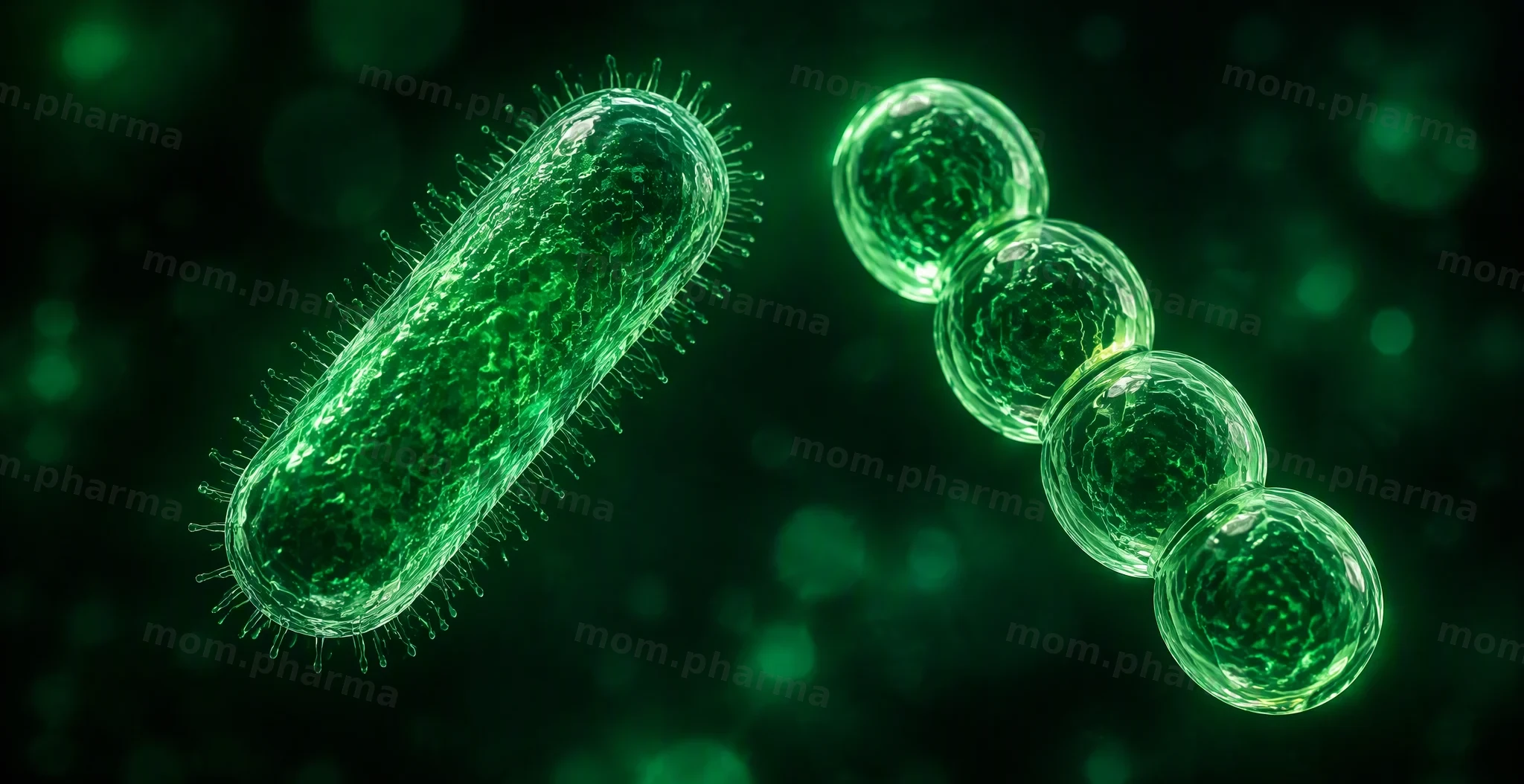
Probiotics are live microorganisms which, taken in adequate amounts, benefit the host: that is the definition of FAO and the World Health Organization from 2001, confirmed in 2014 by ISAPP as well (Hill and colleagues). The key word here is strain: the benefit comes from the specific strain, for example Streptococcus salivarius K12, not from the whole species.
This is exactly the mistake I correct most often. K12 is not a gut strain: it colonises the mouth and the throat, so its form is a lozenge, not a capsule to swallow. It is taken in the evening, after brushing the teeth, so it stays in the mouth overnight. I tell every customer: if you swallow it like a pill, the effect is lost. Half the people with this product had swallowed it and then wondered why nothing had changed.
The first question is not "how many billion CFU (colony-forming units) are in it?", but "which strain is this and what has it been studied for?". K12 for the mouth and throat cannot be measured against Lactobacillus rhamnosus GG for the gut, and a multi-strain product is not automatically stronger if none of its strains has studies for the goal you are after.
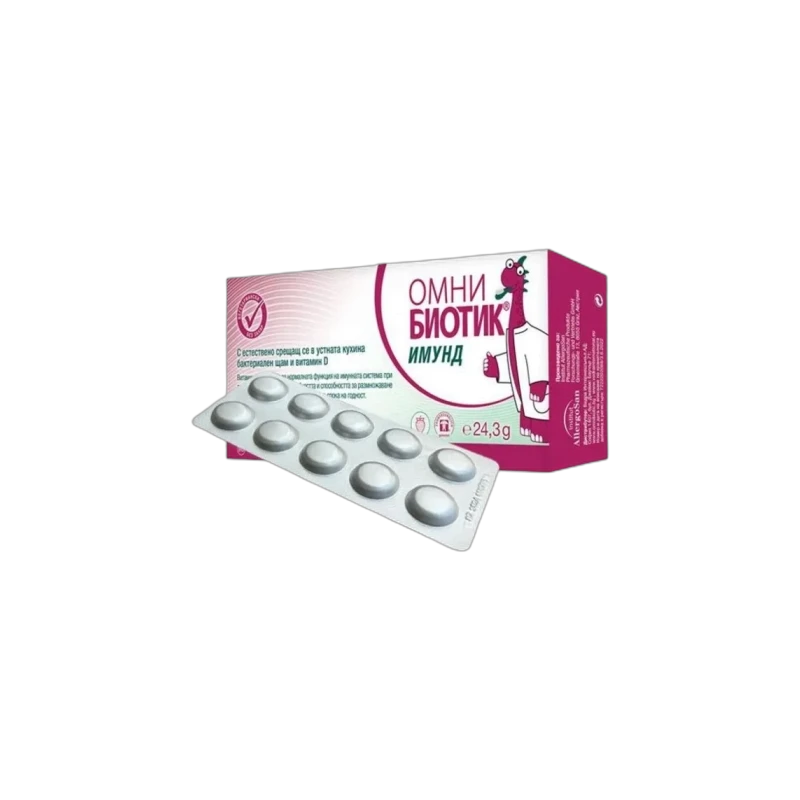
The product from this article
OMNi-BiOTiC Immund lozenges, 30 pcs
Didi: Probiotic supplement with the Streptococcus salivarius K12 strain and vitamin D, which contributes to the normal function of the immune system. There is no approved health claim for the strain itself. For children over 3 years.
What the law allows and what the studies measured

I will be completely honest: in the EU there is no approved health claim for a single probiotic strain, and the Irish authority FSAI treats the very word probiotic on a label as a health claim. The only exception in Regulation (EU) No 432/2012 concerns the live cultures in yoghurt, and only for the digestion of lactose in the product itself in people with intolerance.
For K12 there are data worth knowing, as long as they are read soberly. In children during their first year of kindergarten, six months of regular intake was linked to fewer episodes of streptococcal throat infections, about 16% with K12 versus about 48% in the control group, and fewer cases of acute otitis media, about 44% versus about 80% (Di Pierro, 2016). And the caveats: the studies come mainly from one team, they are small and open-label, and K12 does not cure tonsillitis. The largest randomised trial on the topic came in 2023: 827 children aged 1 to 6 in 50 day care centres in Finland, six months of K12 or placebo, and no effect against acute otitis media was found (Sarlin and colleagues, JAMA Network Open).
For respiratory infections the largest review is Cochrane 2022: 24 studies with nearly 7,000 people. Probiotics lowered by about 24% the number of people with at least one acute respiratory infection and by about 42% the use of antibiotics for them. The effect is modest, strain-dependent, and the evidence quality is moderate to low. This is not a vaccine substitute.
Another solidly studied topic is antibiotic-associated diarrhoea in children. The 2019 Cochrane review summarises 33 studies with over 6,300 children: probiotics, most often Lactobacillus rhamnosus or Saccharomyces boulardii, lowered the risk from about 19% to about 8%.
How to take them and how to store them
With an antibiotic the probiotic is taken throughout the whole course, not only after it, but not together with the antibiotic either: for gut strains the gap is at least two hours. For K12, which works in the mouth, this obstacle does not apply, but the rule stays: evening, after washing the teeth.
How it is stored you will find on the label, because strains are not equally resilient. K12 is stable at room temperature, while some lactobacilli need the fridge. In both cases the box does not stay in the car in summer and does not sit next to the radiator.
And the expectations I discuss with every parent. A probiotic complements the routine but does not replace sleep, food and vaccines. To the mother who wants the child to catch nothing at kindergarten I say: fewer infections and shorter episodes, no miracles. Who does what for immunity and what the role of vitamin D is, I tell in the article about immunity at kindergarten and in the article about vitamin D for babies.
The product I give as an example
In the pharmacy, for K12 I show Omni-Biotic Imund: one tablet carries 1 billion live bacteria of the strain and 5 micrograms of vitamin D3, the reference value for the day. Vitamin D carries the approved claim: it contributes to the normal function of the immune system (Regulation (EU) No 432/2012). For the K12 strain itself there is no approved claim, so I speak about it only with the study data above. The tablets are sugar-free, strawberry-flavoured, for children over 3 years: one tablet daily for children, two tablets daily for adults.
The myths I hear in the pharmacy and see on the internet
"Yoghurt is a probiotic for immunity." This is the specifically Bulgarian myth. The EU-approved claim for the live cultures in yoghurt covers only the digestion of lactose in the product itself. Yoghurt is a valuable food, but it does not cure.
"The more billions and strains it has, the better." Only if the strains are studied for the goal you are after: the CFU count matters for the specific strain, not on its own.
"Probiotics cure allergies, acne and eczema." For most of these conditions the evidence is insufficient, while for food supplements in Bulgaria and the EU claims that they cure disease are banned: such claims are only for medicines. That is exactly why one is registered as a medicine, because it cures disease, and the other is registered as a food supplement, which protects health and gives tone.
When the probiotic is not the solution
A child under three: lozenges carry a choking risk, and the format and strain are chosen with the paediatrician. Tonsillitis with fever, purulent tonsils or pain over 48 hours is a doctor's call: streptococcal infection is treated with an antibiotic, and K12 is not a treatment. People with severely weakened immunity, for example after transplantation or during oncology treatment, take probiotics only after a medical decision: rare cases of bacteraemia have been described. Blood in the stool, severe or long diarrhoea and fever with diarrhoea are not self-treated. With an allergy to ingredients the label is read carefully: the lactose in K12 tablets is under 2 milligrams, but with a severe milk protein allergy ask a pharmacist.
If you are wondering which product suits you or your child, ask me in the chat: I answer personally and free of charge, for information only, without diagnosis and without changing therapy.
Sources
This article was written by Donka Arabadzhova, Master of Pharmacy, and confirmed by the following sources: FAO/WHO (2001) and Hill C. et al., Nature Reviews Gastroenterology & Hepatology, 2014 (ISAPP), the definition of a probiotic; Regulation (EU) No 432/2012 on permitted health claims and the FSAI position on probiotic claims; Di Pierro F. et al., European Review for Medical and Pharmacological Sciences, 2016; Sarlin S. et al., JAMA Network Open, 2023: K12 and acute otitis media in day-care children; Zhao Y. et al., Cochrane Database of Systematic Reviews, 2022 (CD006895); Goldenberg J.Z. et al., Cochrane Database of Systematic Reviews, 2019 (CD004827); product information from Allergosan for Omni-Biotic Imund.
The product from this article
OMNi-BiOTiC Immund lozenges, 30 pcs
Didi: Probiotic supplement with the Streptococcus salivarius K12 strain and vitamin D, which contributes to the normal function of the immune system. There is no approved health claim for the strain itself. For children over 3 years.
This article is for informational purposes only and does not replace a consultation with a doctor or pharmacist about your specific condition. The product cards in it lead to pages with affiliate links: if you buy through them, I earn a small commission at no extra cost to you.
I answer personally and free of charge, for information purposes only, without diagnosis and without changes to your therapy.
If this article was useful and you think it will help someone, share it. That is how my work and knowledge reach more people.